Clifton Elite Roofing provides commercial roofing in Clifton, NJ, serving surrounding cities including Woodland Park, Wallington, Wood-Ridge, Rutherford and Totowa. For more than 20 years we have repaired and replaced low-slope roofs on storefronts, offices, mixed-use buildings, small warehouses and multifamily properties, alongside our residential work.
Commercial roofs fail differently from house roofs. Water sits longer, rooftop equipment punctures the membrane in dozens of places, and a leak can shut down a business or damage a tenant’s space. We plan each job around those realities, and around the fact that commercial re-roofs in New Jersey go through the local construction office rather than the ordinary-maintenance exemption that covers most houses.
Commercial Roofing Systems We Install
EPDM Rubber Roofing
EPDM is a synthetic rubber membrane installed fully adhered, mechanically fastened or ballasted, and it has a long track record on flat roofs. It tolerates movement and temperature swings well. We pay particular attention to seam tape, perimeter flashing and the details around curbs and drains, which is where rubber roofs usually fail.
Older EPDM roofs often show shrinkage at the perimeter, where the membrane pulls away from walls and curbs and stretches the flashing tight. Catching that early lets us reflash the edges before the membrane tears, which buys an aging roof more years at a fraction of the cost of replacement.
TPO and PVC Single-Ply Membranes
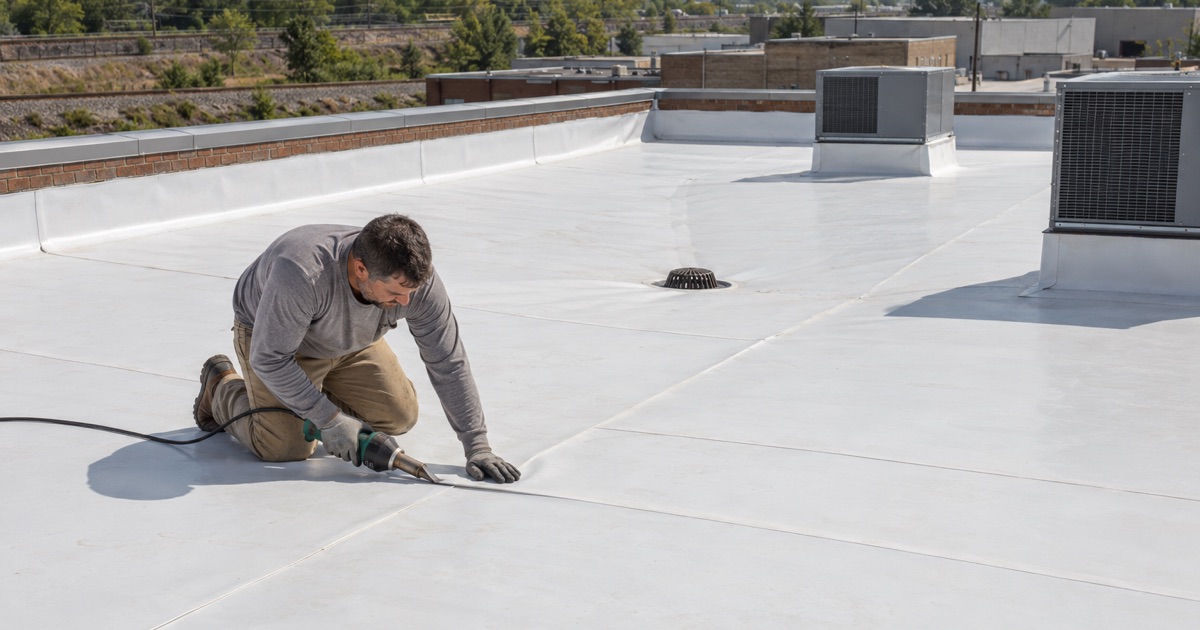
TPO and PVC are thermoplastic membranes whose seams are welded with hot air into a single continuous sheet. Their light, reflective surfaces reduce heat gain on the building. PVC holds up particularly well where grease or chemicals reach the roof, such as above restaurant kitchen exhausts.
Because the seams are welded rather than glued, a well-installed single-ply roof has few weak lines, but every weld has to be probed after installation. We check seams along their full length so a cold weld does not open up in the first hard winter.
Modified Bitumen
SBS and APP modified bitumen roofs are built in layers with a granulated cap sheet, and they handle foot traffic and rooftop service work better than many single-ply systems. They suit roofs with heavy equipment access and smaller roofs with lots of penetrations, where the multi-ply build adds redundancy.
Repairs to modified bitumen also tend to be straightforward, since new cap sheet can be torched or adhered to a cleaned, primed surface. That makes it a practical choice for owners who expect frequent rooftop work from mechanical and electrical trades.
Metal Roofing on Commercial Buildings
Standing seam metal works well on commercial buildings with enough slope, mansards and architectural canopies. On buildings with a pitched front and a flat rear, we often combine metal or shingles on the visible slopes with a membrane on the low-slope section, detailed carefully at the transition.
Commercial Roof Repair and Maintenance
Leak Investigation on Occupied Buildings
Water on a flat roof can travel under the membrane and through insulation before it finds a seam in the deck, so the leak inside may be far from the opening above. We trace leaks from the interior and the roof together, make temporary repairs to protect tenants, and then fix the source.
Drains, Scuppers and Ponding Water
Ponding water accelerates membrane aging, adds weight and finds every weak seam. We clear and reflash drains and scuppers, check that the edge metal is not trapping water, and identify where the roof’s slope itself is the problem. New Jersey’s 2024 building subcode adopts the IBC requirement to analyze susceptible roof bays for ponding stability when a low-slope roof is recovered or replaced.
Rooftop Units and Penetrations
HVAC curbs, exhaust fans, pipe penetrations and conduit supports are the most common leak points on commercial roofs, and they are often disturbed by other trades. We reflash curbs, install proper pipe flashings and pitch pans, and note damage caused during equipment service so owners can address it with the responsible contractor.
Preventive Maintenance and Condition Reports
A spring and fall inspection catches clogged drains, opened seams and loose flashing before they become wet insulation. We document each visit with photos and a written condition report, giving owners and managers a record of the roof over time and a basis for planning capital work.
Commercial Roof Replacement
Recover Versus Full Tear-Off
A recover installs new insulation and membrane over the existing roof, which can save cost, but only when the existing roof is dry and the building has not reached its layer limit. We use moisture surveys and core cuts to see what is under the membrane before recommending a recover or a full removal.
Insulation, Cover Boards and Tapered Systems
Replacement is the best time to improve drainage and energy performance. Tapered insulation can create slope toward drains on a dead-flat deck, and cover boards protect insulation from foot traffic and hail. We design the assembly around drainage first, since a roof that holds water will not last however good the membrane is.
Phasing Work Over Occupied Space
We replace commercial roofs in sections that are watertight at the end of each day, coordinate rooftop unit disconnects with your mechanical contractor, and plan crane lifts, deliveries and debris removal around business hours and municipal dumpster rules, so tenants keep operating while the roof is replaced.
Multifamily, Mixed-Use and Association Roofs
Mixed-Use Buildings and Apartments
Many commercial corridors in this area have storefronts with apartments above, and three- and four-family buildings with flat or low-slope roofs. These roofs are outside New Jersey’s ordinary-maintenance exemption, so they are permitted through the construction office, and the work has to be coordinated with residents as well as business tenants.
Condominium and Association Roofs
New Jersey’s Structural Integrity Law, P.L.2023, c.214, requires covered associations to fund capital reserves from a reserve study with a 30-year funding plan. Roofs are one of the largest items in that plan. Our inspections and condition reports give boards real observations about remaining roof life to share with their reserve specialist.
- 20+ Years on North Jersey Roofs
- Itemized Written Scopes
- Attic-to-Ridge Leak Tracing