Clifton Elite Roofing handles chimney flashing repair in Clifton, NJ, serving surrounding cities including Woodland Park, Wallington, Wood-Ridge, Rutherford and Totowa. On the older houses that line so many North Jersey streets, tall brick chimneys are one of the most common sources of roof leaks we see, and in more than 20 years we have learned that most of them come down to the metal where the brick meets the roof.
Good chimney flashing is built in layers. Step flashing is woven in with each course of shingles, counter flashing is cut into the brick and folds down over it, and a cricket behind wider chimneys sends water around instead of letting it pond. When any of those layers is missing, rusted or replaced with a bead of caulk, water finds its way in.
We trace every chimney leak from the attic as well as the roof, so we know whether the problem is the flashing, the brickwork, the crown or something else before we start cutting metal.
How Chimney Flashing Works
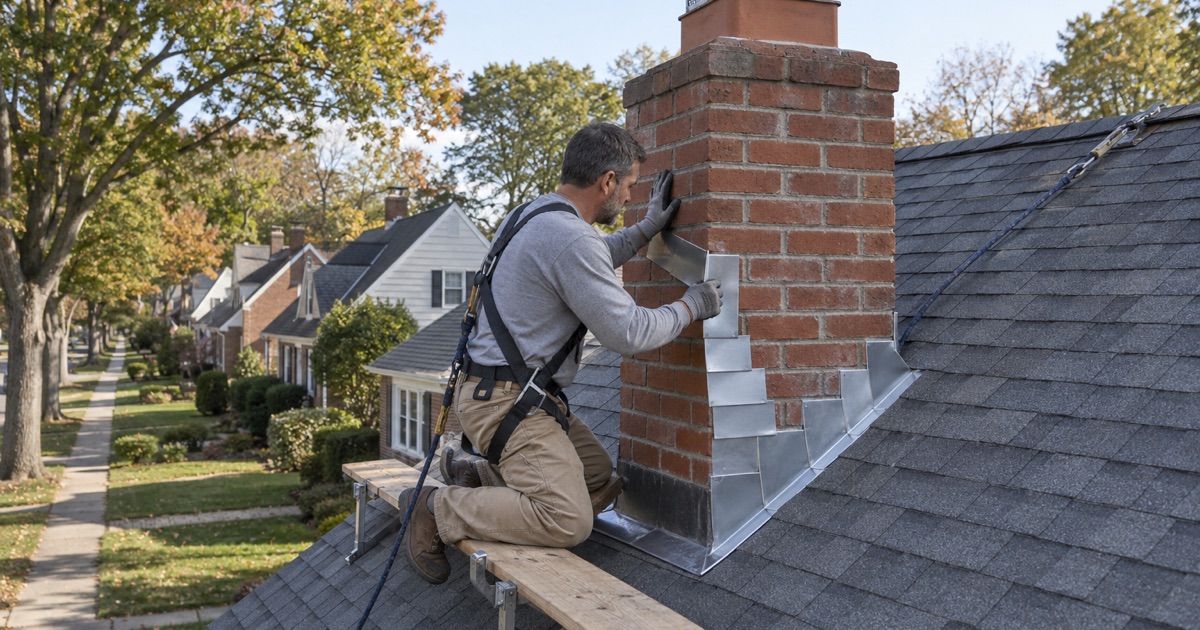
Step Flashing Along the Sides
Step flashing is a series of individual L-shaped pieces, one per course of shingles, that run up each side of the chimney. Each piece overlaps the one below, and each shingle covers the piece beneath it, so water is passed down the roof in steps rather than being asked to flow over a single long joint.
When step flashing is replaced with one continuous strip, or when the shingles are cut short of the metal, water runs along the joint and into the roof. We rebuild step flashing piece by piece with the new shingle courses.
Counter Flashing and Reglets
Counter flashing covers the top of the step flashing and keeps water from running down the face of the brick behind it. On a proper installation, it is cut into a mortar joint or a sawn groove called a reglet, then sealed, so the brick and the metal can move independently without opening a gap.
Face-nailed counter flashing, or metal simply glued to the brick, pulls loose as the masonry and the roof move through the seasons. Cutting it into the brick is more work and the only method we use.
Apron Flashing on the Downhill Side
The front of the chimney, facing down the roof, gets a one-piece apron flashing that laps over the shingles below and up the brick behind the counter flashing. It is usually the simplest part of the system, but it is often bent, cracked or loose on older roofs where previous repairs have been layered over it.
Crickets, Wide Chimneys and Older Houses
Chimney Crickets and Saddles
On the uphill side of a chimney, water, snow and leaves pile up against the brick. A cricket, or saddle, is a small peaked roof built behind the chimney to split that flow and send it around both sides. Building codes require one when a chimney is wider than 30 inches parallel to the ridge and does not sit at the ridge.
The cricket itself is framed, sheathed and covered with metal or roofing, then flashed and counterflashed to the brick like any other roof-to-chimney joint. Done right, it removes the single most common place for chimney leaks to start.
Tall Brick Chimneys on Prewar Houses
Prewar houses in Clifton and the surrounding towns often have tall brick chimneys, steep roofs and decades of flashing repairs layered over one another. We strip back old tar, caulk and patched metal to see what is really there, then rebuild the flashing from the roof deck up.
On these chimneys, we also look closely at the mortar joints where counter flashing will be cut in. If the joints are soft or crumbling, the masonry needs repointing before new flashing can hold.
Copper and Lead-Coated Copper Flashing
On slate roofs and on houses where the original details were copper, we flash chimneys in copper or lead-coated copper, which last as long as the slate around them. On shingle roofs, we use corrosion-resistant metal suited to the roofing and the masonry, and never mix metals that will corrode each other.
When the Leak Is Not the Flashing
Chimney Crowns and Caps
The concrete or mortar crown on top of a chimney sheds water away from the flue. When it cracks, water soaks down into the masonry and appears at the roof line, looking exactly like a flashing leak. A missing or damaged cap lets rain straight down the flue. We check both as part of every chimney leak call.
Brick, Mortar and Masonry Problems
Porous brick and eroded mortar joints above the roof can absorb water and pass it down inside the chimney. When we find masonry problems, we tell you plainly, because new flashing on a chimney that is soaking up water through its brickwork will not stop the leak on its own.
Chimney Flashing With a New Roof
Replacing Flashing During a Re-Roof
Every roof replacement we do includes new chimney flashing. Old step flashing is fastened under the existing shingles and cannot be properly reused, and counter flashing that has already been bent back and forth rarely seals well again. Replacing it with the roof costs far less than coming back for it after the first leak.
Ice and Water Protection Around the Chimney
Before new flashing goes on, we install self-adhering ice and water membrane on the deck around the chimney, extending up the sides of the brick under the step flashing. It seals around nail shanks and adds a second line of defense where water and ice collect most.
- 20+ Years on North Jersey Roofs
- Itemized Written Scopes
- Attic-to-Ridge Leak Tracing